Hello there! Today we’ll explore South Africa in relation to Hofstede’s dimensions, in order to know what they’re like and if they have anything in common with colombian culture!
HOFSTEDE’S DIMENSIONS
According to Hofstede Insights the score of over half of the cultural dimensions regarding Colombia and South Africa is similar. We’ll check each dimension to figure out similarities and differences.
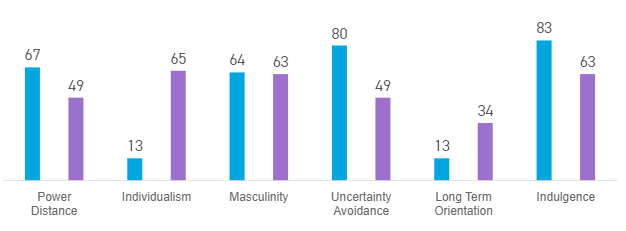
- Power Distance: according to Hofstede, this dimension deals with the fact that all individuals in societies are not equal – it expresses the attitude of the culture towards these inequalities amongst us. Colombia scored higher than South Africa, meaning that colombians often feel inequalities are just a fact of life. South african accept less the distribution of power. Both cultures reflect a hierarchy structure with concentrated power.
- Individualism: this dimension has to do with whether people’s self-image is defined in terms of “I” or “We”. According to the chart, Colombia is rather a collective nation. People in here will mostly belong in groups that take care of them in exchange for loyalty. On the other hand, South Africa is a country with a high level of individualism, meaning family is a key element in their culture. This actually has to do with the fact that tribes, before considered families, were the begninning of this society.
- Masculinity: both countries scored a high level of masculinity, meaning that their cultures are based on competition, achievement and success. This probably has to do with the gender inequality that characterizes both societies. Success is given in material things. We see that both countries thrive on economic growth and, on the individual level, seek a life that’s full of cars, houses and other people’s approval to find happiness.
- Uncertainty avoidance: has to do with the way that a society deals with the fact that the future can never be known. Colombia scored high, which means colombians are not comfortable with future ambiguity. This may be due to the strong religious roots that the country has, and so they seek for an answer to everything. They care about consequences and punishment and therefore have a lot of rules. On the contrary, South Africa shows, according to its score, a more relaxed attitude in which practice counts more than principles and deviance from the norm is more easily tolerated.
- Long term orientation: both countries scored low on this dimension, which means they have to maintain links with their past as they face the challenges of the future. Full of time-honored traditions, Colombia is one of the most conservative cultures there is. Change is not well accepted, which may be due to the armed conflict which showed the violence that came with the alternative. South Africa tends to be more pragmatic than Colombia, but maintains doubt towards change.
- Indulgence: This dimension is defined as the extent to which people try to control their desires and impulses, based on the way they were raised. Both countries scored high, meaning they have week control. The colombian mothers are rather indulgent toward their children: they let them play and have fun as they please. As a consequence, this society has a tendency towards optimism and leisure time plays an important role for them. This also applies to south african culture.
Colombian culture is very similar to a lot of other Latin American countries, with a few special elements that make it unique. Looking at Colombian history, for example, the Spanish colonial era has left a lasting influence throughout the country, with a high rate of Roman Catholics in Colombian society. The Spanish decimated the indigenous population here, yet many elements live on in Colombian customs, music, and language.
On the other hand, South Africa has been famously referred to as the rainbow nation because it is made up of so many diverse cultures and religions. Contained within South Africa’s borders are Zulu, Xhosa, Pedi, Tswana, Ndebele, Khoisan, Hindu, Muslim, and Afrikaner people to name but a few.
 A journey to South Africa